

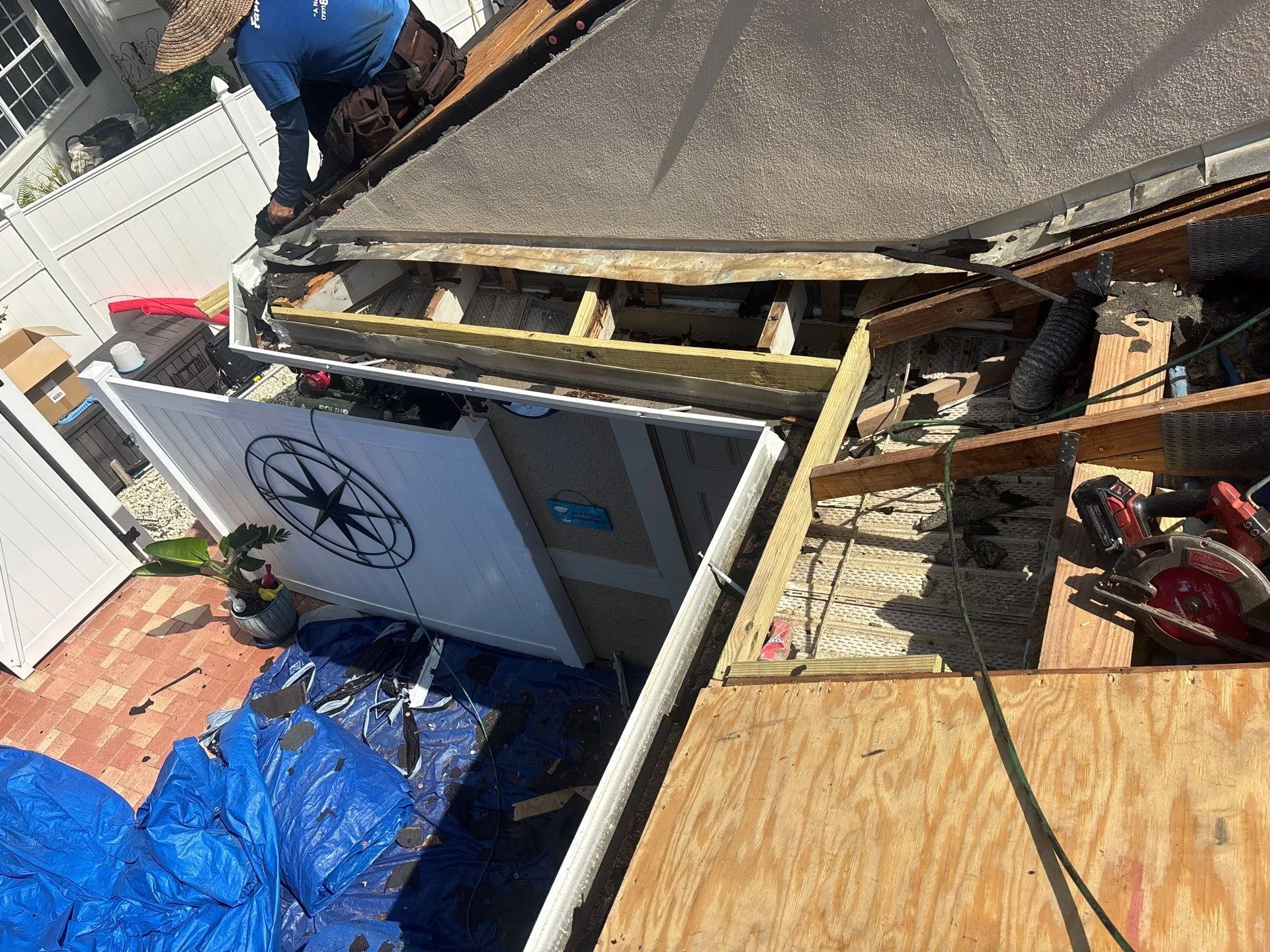
A man off Trouble Creek Road in New Port Richey called us on a Thursday afternoon with a storm four days out in the Gulf. He had noticed a lifted shingle a couple months earlier and had been meaning to get to it. We were out the next morning, spent about forty minutes resealing that section and two others he had not noticed, and were gone before lunch. The storm turned north and never hit us. He still calls it the best two hundred and eighty dollars he ever spent, because he did not spend that weekend wondering.
This guide is for that window. A storm has a name, there is a cone, and you have roughly seventy two hours. This is a different job than spring preparation. You are not fixing everything. You are finding what will fail, fixing what can still be fixed, and getting the record straight on the rest.
The seventy two hour timeline
Three days out. Do the walk around. Call a roofer about anything genuinely loose. This is the last day it is realistic to get one out.
Two days out. Clear gutters, secure or bring in everything in the yard, trim what you safely can from the ground.
One day out. Photos, documents, and the inside work. Nobody should be on a ladder at this point.
Landfall day. You are done. Stay inside, follow Pasco County Emergency Management, and know your evacuation zone.
The Ground Level Walk Around
All of this is done from the ground with binoculars or a zoomed in phone camera. Do not get on the roof. A pre storm fall from a ladder is one of the more common ways Floridians get hurt in hurricane season, and it happens before the weather ever arrives.
Walk the perimeter and look at the edges
Start at a corner and work all the way around the house. You are looking at the drip edge along the eaves, the rake edges running up the gable ends, and the ridge cap along the peak. These are the highest uplift areas on any roof and they fail first.
Any shingle that is lifted, curled at the corner, cracked, or sitting at a slightly different angle than its neighbors has broken its seal. In a hurricane it is gone, and it takes the course above it along.
Zoom in on every pipe boot and vent
Look at each plumbing vent stack. If the rubber collar is gray, chalky, or split, water is going to come through it during twelve to twenty hours of horizontal rain. Look at your turbines, ridge vents, and any off ridge vents for loose flashing or missing screws.
This is genuinely fixable in a couple of hours. If a roofer can still get to you, a boot replacement is one of the highest value pre storm calls you can make.
Push on the soffit
Walk the perimeter again, this time looking straight up at the underside of the eaves. Push gently on a few panels. Any panel that is loose in its channel, sagging, or already partly out needs to be secured before the storm.
Soffit failure is how wind gets into the attic. Once the attic pressurizes from below while wind is pulling from above, the roof deck itself can go. This is a small repair that prevents an enormous one.
Clear the gutters and downspouts
A hurricane brings more rain in a day than we usually see in a month. A clogged gutter fills, gets heavy, and pulls away from the fascia, and the water it should have carried away goes back under the shingle edge instead.
Make sure downspouts are attached and directing water away from the foundation. If you have gutter guards, look for debris sitting on top of them.
Clear the yard completely
Anything not tied down becomes a projectile, and most of what puts holes in Pasco County roofs is not from the neighbor's house. It is patio furniture, planters, grills, umbrellas, pool equipment, trash cans, and lawn decorations from your own yard.
Bring it inside or into the garage. If a piece is too large to move, get it into a corner against the house and secure it. Take down anything hanging, including flags, wind chimes, and hanging plants.
Take the photos
This is the step people skip and regret. Photograph every slope of the roof, all four elevations of the house, the gutters, the soffits, the fence, the pool cage, and the vehicles. Get the inside too, especially ceilings, and open a closet or two to show contents.
Timestamped photos taken the day before landfall are the cleanest possible evidence of what your property looked like before the storm. If you file a claim, this is what separates a smooth process from a fight. More detail in the photography guide.
The Inside Work, Twenty Four Hours Out
Once you are off the ladder for good, there is still useful work to do. Find your homeowners policy and read the declarations page, specifically the hurricane deductible. In Florida that is usually a percentage of the dwelling coverage rather than a flat dollar amount, often two percent or five percent. On a home insured for four hundred thousand dollars, a two percent hurricane deductible is eight thousand dollars out of your pocket before the carrier pays anything. It is much better to learn that now than in the middle of a claim.
Save your carrier's claim phone number in your phone, and write it on paper too. Cell service gets unreliable and phones die. Put the policy number, the agent's name, and the claim line on a card in your wallet.
Then prepare the inside for water. Move anything valuable off the floor and away from exterior walls. Clear the attic access so you can get up there quickly if you need to. Put a few buckets, some old towels, and a roll of plastic sheeting somewhere you can reach in the dark. If water does come through, having those staged saves your drywall and your flooring.
What not to do before a storm
Do not get on the roof. Not to look, not to fix, not to tarp. Wind ahead of a storm is gusty and unpredictable, and more people get hurt preparing for hurricanes than during them.
Do not nail plywood over your roof. People ask about this every year. It does not help, it puts dozens of new holes through your roof covering, and the plywood itself becomes a hazard. Board the windows, not the roof.
Do not put a tarp up preemptively. A tarp on an intact roof in hurricane wind is a sail. It will catch, lift, and take shingles with it. Tarping is an after the storm tool. See the tarping guide for how it is actually done.
Do not sign anything with a door knocker. Crews appear ahead of storms as well as after them. Nothing that needs signing today cannot wait until the storm passes.
When not to spend money with us
If the walk around turns up nothing and your roof is in decent shape, do not call us for a pre storm inspection just to feel better. We will be honest with you: at seventy two hours out, our crews should be going to the homes with genuinely loose material, because those are the ones that will otherwise become claims.
And if the storm is now inside forty eight hours, do not pay emergency rates for cosmetic work. Secure the soffit, secure loose shingles at the edges, and let the rest wait. Anything that is not going to fail in this storm can be fixed properly in two weeks for a normal price.
Know your evacuation zone before you need it. Pasco County uses lettered zones A through E, and coastal neighborhoods in Port Richey, Hudson, and Holiday go first. Your roof matters, but your family leaving on time matters more. Nothing on this page is worth staying for.
If something on the walk around looked wrong, call Farrell Roofing at (727) 845-7663. We are local, we are on Commerce Ave in Port Richey, and our Florida license is CCC1327707. We serve Port Richey, New Port Richey, Hudson, Holiday, Trinity, Tarpon Springs, Palm Harbor, Odessa, Land O' Lakes, and Spring Hill. When the storm passes, we do storm damage repair and work directly with your adjuster.
This Resource Center provides general educational information for Florida homeowners. It is not legal, insurance, engineering, or emergency management advice. Always follow instructions from local emergency management officials, and contact your insurance carrier with questions about your individual policy or claim.
For official storm information and evacuation orders, see the National Hurricane Center, Florida Division of Emergency Management, and Pasco County Emergency Management.