

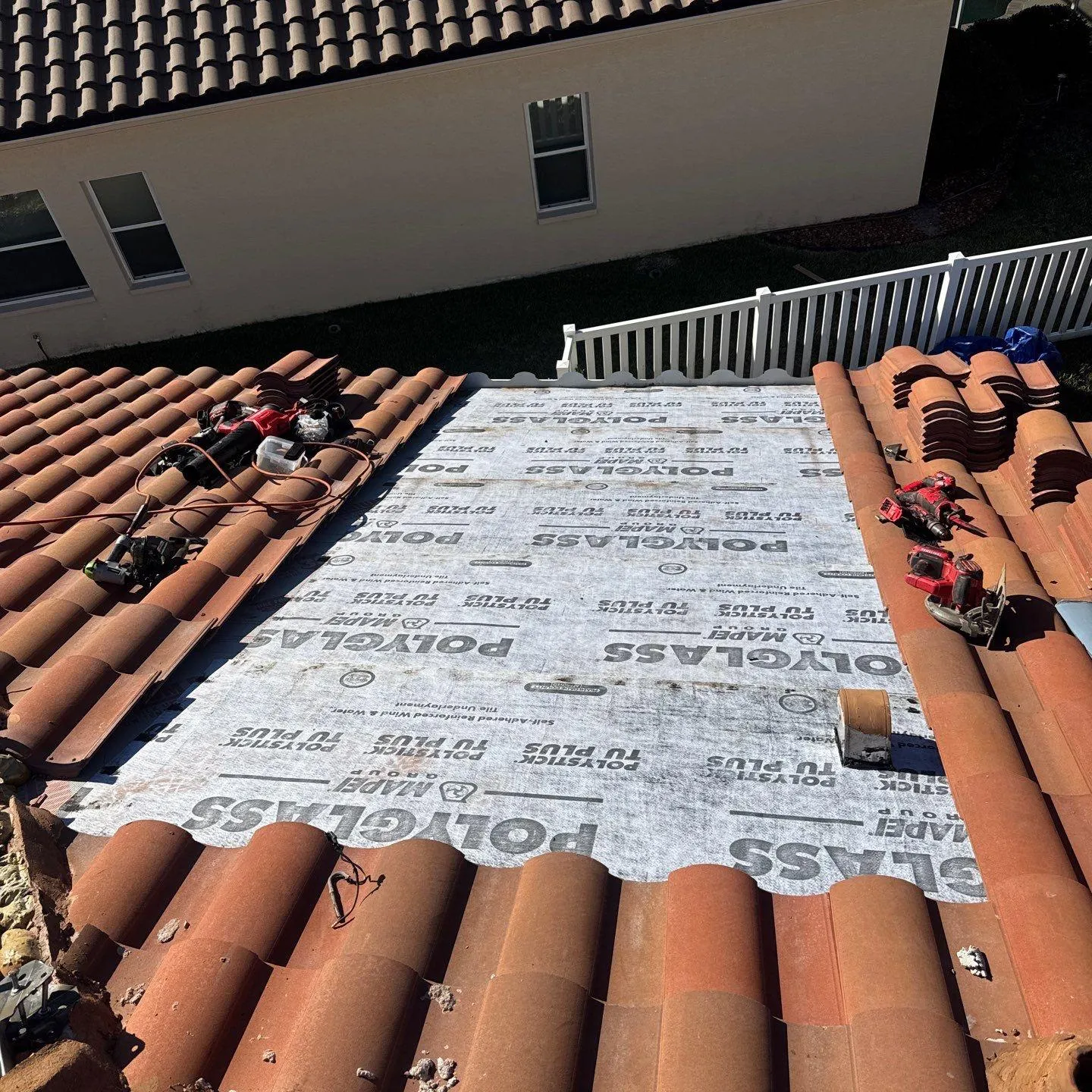
A homeowner in Gulf Harbors put a tarp on his own roof the morning after a storm. Blue poly from the hardware store, held down with bricks and a few bungee cords at the corners. It looked fine for about three days. Then an ordinary afternoon thunderstorm came through, the wind got under one edge, and the whole thing went over the ridge like a kite. It took a row of intact shingles with it, and the six hours of rain that followed did more interior damage than the hurricane had.
That is the honest case for understanding tarping. A proper emergency tarp is a temporary roof. It is screwed down through wooden battens, it laps well past the damage, it goes over the ridge, and it holds for thirty to ninety days. A tarp with bricks on it is a hazard pretending to be a repair.
What a Real Emergency Tarp Is
The material matters first. A professional tarp is heavy duty reinforced polyethylene, generally ten mil or heavier, and often a woven reinforced sheet rather than the thin blue plastic sold for covering firewood. The cheap ones tear at the grommets within days of Florida sun and wind.
The attachment matters more. The tarp is not weighted down. It is rolled around wooden furring strips, usually one by three or two by four, and those battens are screwed through the tarp and into the roof deck. The edges are wrapped so water cannot track back under the batten and into the screw holes. Done correctly, the wind has no loose edge to catch, which is the only thing that actually makes a tarp fail.
And the coverage matters. A tarp needs to extend at least three to four feet past the damage in every direction, and it needs to run over the ridge and down the far slope so water cannot run under the top edge. Tarps that stop short of the ridge are the most common mistake we see, and they leak from day one.
Yes, a proper tarp puts holes in your roof
Homeowners often balk at this. The battens are screwed through the roof covering and into the decking, which means new penetrations. That is correct and it is intentional.
Those screw holes are sealed during the permanent repair, and on a roof that is getting replaced anyway they are irrelevant. A few dozen sealed screw holes are a trivial cost next to another four weeks of water coming into your house. Anyone who tells you they can secure a tarp in Florida weather without fasteners is selling you the bricks and bungees version.
How the Job Actually Goes
Assess and photograph before covering
Before anything gets covered, the damage gets documented. Photos of every damaged area, the decking condition, and the extent of missing material. Once a tarp is on, an adjuster cannot see what is underneath, and you do not want that conversation later.
Clear the debris
Loose shingles, branches, and any sharp debris come off first. A tarp stretched over a broken branch has a hole in it by morning. Protruding nails get pulled or flattened.
Set the battens and roll the edges
The tarp is positioned to lap well past the damage and over the ridge. Each edge is rolled around a furring strip so the fabric is captured, then the strip is screwed down into the decking on a regular spacing. Rolling the edge is what keeps wind from peeling the tarp off the fasteners.
Seal the top edge and check the water path
The top edge over the ridge gets particular attention, because that is where water runs to. The crew then walks the whole perimeter looking for any place water could get under an edge or pond on the surface. A tarp that holds water is a tarp that fails.
Document again and give you the paperwork
Photos of the completed tarp, an invoice that describes the emergency mitigation clearly, and a written note of what was found underneath. That invoice is a reimbursable mitigation expense on most policies, so it needs to be specific. See the insurance documentation guide for how it fits into the claim.
What Tarping Costs in Pasco County
For a typical single story residential roof, a professional emergency tarp generally runs $400 to $1,200 depending on the size of the area, the pitch, and access. Steep roofs, two story homes, tile roofs, and very large areas run higher, sometimes $1,500 to $3,000. Materials are a small part of that. You are paying for people on a damaged roof.
Most homeowners policies reimburse reasonable emergency mitigation costs, and tarping is the textbook example. Keep the invoice and the photos. Be careful, though, of post storm pricing that has drifted from reasonable into opportunistic. Florida Statute 501.160 prohibits price gouging on essential commodities and services during a declared state of emergency, and the Attorney General's office runs a price gouging hotline during activations.
Operation Blue Roof
After a presidentially declared disaster, the U.S. Army Corps of Engineers sometimes runs Operation Blue Roof in affected counties. It installs heavy plastic sheeting on eligible primary residences at no cost to the homeowner. You sign a right of entry form, and crews work through a queue.
It is a real program and worth applying for if it activates for Pasco County. Two things to know: it is a temporary cover rather than a repair, and the queue after a major storm can be long. If water is actively coming into your house, get a tarp on now and let the program be a backup rather than the plan.
If You Are Going to Do It Yourself
We would rather you did not, and we will say why plainly. Falls from roofs and ladders are among the most common serious injuries after hurricanes in Florida, and a storm damaged roof is the worst possible surface to learn on. Decking can be soft where it looks solid.
If you are going to anyway, do it only on a dry roof with no wind, never alone, and never on a steep pitch or a second story. Buy the heaviest tarp you can find and buy furring strips and exterior screws with it. Lap at least four feet past the damage on every side and run the tarp over the ridge. Roll every edge around a strip and screw it down. Do not use bricks, sandbags, bungees, or rope, all of which fail.
And understand what you have bought yourself. A homeowner tarp done well buys you a couple of weeks. It is a bridge to a repair, not a substitute for one.
Never tarp during these conditions
Do not go up while wind is still gusting, while it is raining, on a wet roof, in the dark, when there are downed power lines anywhere near the house, or when any part of the roof structure looks like it has sagged or shifted. A structural failure under your feet is not survivable in the way a slip is.
If the roof structure itself looks compromised, stay out of the house entirely and call the county. That is not a roofing problem yet, it is a safety problem.
When not to spend money with us
A tarp is for an active opening. If your damage is a few missing shingles with no water coming in, you very likely do not need a tarp at all, and we will tell you that when we look. Paying eight hundred dollars to cover a roof that is not leaking is money spent on worry.
Second, if we can get you a permanent repair inside of a week, and the weather looks settled, we will often recommend skipping the tarp and going straight to the fix. That is one invoice instead of two. When Pasco County is booked out three weeks after a major storm, that math changes and the tarp is worth every dollar.
A tarp is a clock, not a cure. It holds for thirty to ninety days in Florida sun, and the sun degrades the plastic the whole time. Use that window to get your claim documented and the permanent repair or replacement scheduled. Tarps that sit for six months start leaking, and then you are dealing with rotted decking on top of the original damage.
Call Farrell Roofing at (727) 845-7663 for emergency tarping and storm repair. We are on Commerce Ave in Port Richey, Florida license CCC1327707, serving Port Richey, New Port Richey, Hudson, Holiday, Trinity, Tarpon Springs, Palm Harbor, Odessa, Land O' Lakes, and Spring Hill since 2003.
This Resource Center provides general educational information for Florida homeowners. It is not legal, insurance, engineering, or emergency management advice. Always follow instructions from local emergency management officials, and contact your insurance carrier with questions about your individual policy or claim.
For official storm information and evacuation orders, see the National Hurricane Center, Florida Division of Emergency Management, and Pasco County Emergency Management.